

A metal most Americans could not name is now at the center of a legal war between the Trump Organization and The New York Times.
Inside Knowledge?
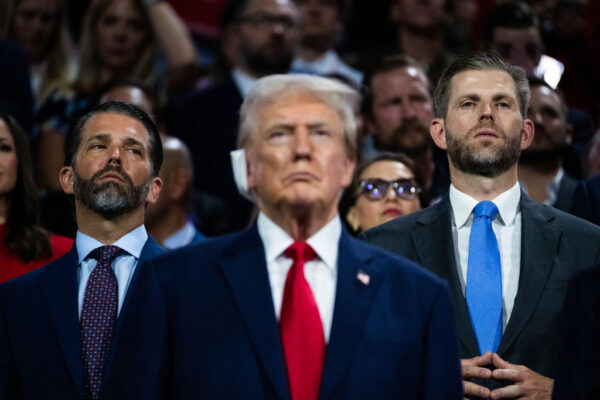
President Donald Trump personally negotiated a government-backed mining deal in Kazakhstan, one of the largest critical minerals agreements of his second term. Buried inside the fine print is a family connection the Times says is impossible to ignore: the president’s own sons are positioned to profit from the deal he helped broker.
According to a report by The New York Times, the deal centers on tungsten, a metal critical for missile warheads, fighter jets, and computer chips. China currently controls most of the global supply.
The federal government has approved preliminary applications for up to $1.6 billion in financing through the Export-Import Bank and the U.S. International Development Finance Corporation. The money would back an American company called Kaz Resources. Trump and Commerce Secretary Howard Lutnick personally negotiated the agreement with Kazakhstan’s president.
The family math adds up fast.
Donald Trump Jr. and Eric Trump are paid advisers and shareholders in Dominari Securities, a Trump Tower firm, holding a stake worth about $7 million. Dominari, along with partner company ASP Isotopes, took a 20 percent stake in the entity handling the Kazakhstan project on October 31. The final deal was signed in Washington just six days later.
Lutnick’s own sons are in the picture too. Brandon and Kyle Lutnick oversee Cantor Fitzgerald, which helped raise $210 million for ASP Isotopes around the same time the deal was closing. Capital raises that size typically net a firm millions in fees.
The Times published its findings, The Trump Organization did not sit quietly. Attorney Alan Garten sent a letter to editor in chief Joseph Kahn demanding a retraction, calling the piece “deeply misleading,” “categorically false,” and “libelous.”
The letter, according to Fox News, argues the brothers are passive investors with no knowledge of the negotiations.
It points to timing as proof: the verbal government agreement came together in September 2025, weeks before the investment connections formed.
The Times is not backing down. A spokesperson noted the Trump Organization does not dispute that the brothers profit, only how involved they were. The letter reserves the right to escalate to a formal defamation suit.
This is not an isolated deal. The Trump and Lutnick families have financial ties to at least 14 companies working with the federal government on critical mineral projects, with more than $8.9 billion in potential funding at stake. Representative Maxine Dexter of Oregon is among those calling for closer scrutiny.
The pattern raises a bigger question about Trump and his associates breaking rules while he is in office.
A separate Wall Street Journal report found that Sheikh Tahnoon bin Zayed Al Nahyan, a senior UAE royal and national security adviser, invested $500 million into World Liberty Financial, the Trump family’s crypto venture, just days before the inauguration. Months later, the administration reversed Biden-era restrictions and approved AI chip sales to the UAE.
The White House says Trump’s assets sit in a trust run by his children. Ethics experts say that setup does not resemble a true blind trust. Congressional Democrats call it further evidence of pay-for-play politics that seems to keep happening in different avenues.
New disclosures, released in June 2026, have added fuel to the fire. Trump’s investment accounts executed more than 3,600 stock trades in the first three months of 2026 alone, totaling between $212 million and $695 million, according to CBS News.
His portfolio spans Apple, Microsoft, Nvidia, and a $960 million stake in World Liberty Financial. His net worth has climbed to roughly $6.1 billion.
Sen. Elizabeth Warren has questioned whether a sitting president trading individual stocks creates conflicts when his own policies move those same markets. Trump maintains that outside brokerage firms direct the trades without his involvement.
The White House denies any wrongdoing. They are framing the mineral deals and financial arrangements as matters of national security and independent management.
Whether that holds up in Congress, or in court against the Times, is the question hanging over the rest of Trump’s term.


