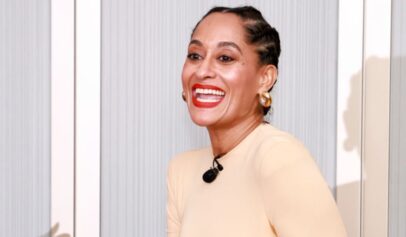

For many A-list actors, launching a business is often treated like a high-end hobby, fueled by years of Hollywood paychecks. But as actress, producer, and entrepreneur Tracee Ellis Ross made clear during her October appearance on the podcast “Aspire with Emma Grede,” her path to founding Pattern Beauty was neither self-indulgent nor self-funded. Instead, it was a strategic masterclass in leveraging value, vision, and influence in an industry where Black women are often underpaid. Grede is the co-founder of the denim company Good American and a founding partner of Skims.
The Making of Pattern
Toward the end of the conversation, Grede brought up a common assumption about Pattern’s origins. “You self-funded this brand, right?” she asked.
“I did not,” Ross replied.
Grede pushed further. “I thought you— you self-funded? You raised money?”
Ross explained, “I found business partners and they —” before Grede interrupted again, surprised that Ross hadn’t used her own money. Ross clarified, “I purposely did not. Someone told me early on not to use my own money. I will also tell you: I’m a Black actress in Hollywood. I did not have that money to use.”
Grede acknowledged the disconnect between perception and reality.
“Well, that is not the idea that everybody has of you. Yeah, I would imagine that you could just, you know, start a brand and you’d be fine— you’d just take your own money and do that,” she stated in disbelief.
“No,” Ross replied.
Despite her high-profile roles in “Girlfriends” and “Black-ish,” Ross is part of a broader group of Black actresses like Viola Davis, Mo’Nique, Gabrielle Union, and Taraji P. Henson, who’ve spoken out about Hollywood’s pay inequity. Davis has long highlighted the disparity, noting that although her career mirrors those of major white actresses, her compensation and opportunities have not.
“People say, ‘You’re a Black Meryl Streep.’ Pay me what I’m worth,” the “Fences” actress famously said.
Instead of investing her own savings or giving up large equity stakes to venture capital firms, she built a funding model based on her concept’s strength rather than her bank account.
When Grede asked if she regretted not self-funding, Ross was firm.
“Not at all. I’m a majority owner.” She explained the structure she secured with her partners, including the Beach House Group: “I have full creative control, and I am the majority owner of the company. The difference is: I brought this fully fledged idea to my business partners, and when I brought it to them, I already had retail partners.”
By the time Ross sought outside support, Pattern wasn’t just an idea. It was a validated brand with product development underway and distribution interest. Instead of approaching investors from a position of need, she approached them with proof of concept and undeniable market demand. That allowed her to maintain control while leveraging partner expertise to scale.
Ross spent nearly a decade shaping her vision, identifying a major gap in the beauty market for curly, coily, and tightly textured hair. Many investors initially dismissed her.
“They didn’t understand why an actress would have anything to share in the hair space,” she recalled in a 2023 interview with Fortune.
Still, she moved forward, funding early chemist work herself and confirming what she already suspected: most mainstream formulations centered on straight or silky textures.
Pattern launched in 2019 with major retail partnerships and quickly became a standout success, validating Ross’s instincts and long-term strategy.
“I really love being founder and CEO, and I have my arms wrapped completely around marketing, PD, narrative, you know, which package—just all of it,” she said. She added that she has a co-CEO who handles operations and shared services, but most of the company remains in-house with 47 employees.
Tracee Ellis Ross didn’t follow the typical celebrity startup script. It seems she has rewritten it, showing that the strongest power move isn’t cutting the check, but owning the vision.