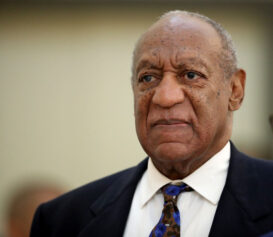

Bill Cosby’s once-formidable New York real estate portfolio is undergoing a quiet but telling reset — one driven less by prestige than by balance sheets, lenders, and timing.
The Foreclosure Battle
The disgraced entertainer’s $6.99 million Manhattan townhouse has been taken off the market after Cosby managed to resolve looming foreclosure issues tied to the property, according to Realtor.com.
The six-bedroom, multistory townhouse on East 61st Street was one of two New York properties facing foreclosure after Cosby and his wife, Camille, were accused of defaulting on multiple loans secured against their homes. Initially listed in April, the property saw its asking price reduced to $6.75 million in July before being delisted entirely on Dec. 3.
Cosby’s listing agent, Adam Schneider of Corcoran Westside Columbus, confirmed that the financial dispute has been settled — for now.
“All issues with the lender have been resolved,” Schneider said in an email, adding that the property is undergoing renovations and is expected to be relisted in the new year. While the precise terms of the lender resolution remain undisclosed, the move suggests a negotiated workout rather than a forced sale.
The timing is notable. Just weeks earlier, Cosby closed a $28 million sale of a far larger Lenox Hill townhouse on East 71st Street, also listed by Schneider.
That property was originally marketed at $29 million in September and sold on Nov. 14 — nearly quadrupling the $6.3 million Cosby paid for it in 1990. The sale likely played a decisive role in stabilizing Cosby’s broader real estate exposure.
At the heart of the financial strain were competing claims from two lenders.
Citi Mortgage, in legal filings from late 2024, alleged Cosby defaulted on a $4.2 million loan tied to the East 61st Street townhouse, claiming approximately $3.7 million remained outstanding in principal, plus interest and fees. The smaller townhouse was purchased in 1980 for $1.2 million and was reportedly used primarily by Cosby’s late son, Ennis.
Meanwhile, First Foundation Bank pursued foreclosure on the East 71st Street mansion, alleging Cosby defaulted on $17.5 million across two loans — $12.25 million from 2010 and $5.25 million from 2014. Court documents filed with the Manhattan Supreme Court state that payments stopped on June 1, 2024, and that more than $300,000 in unpaid property taxes had accrued.
Cosby and his wife, who hold the properties through an LLC, were given until Dec. 12, 2024, to cure the default. First Foundation claims no payment was made.
From a business perspective, selling the East 71st Street property — albeit for $1 million under ask — appears to have been a strategic concession. The transaction likely prevented a public foreclosure auction and preserved remaining equity, while enabling Cosby to renegotiate or resolve the smaller property’s debt.
The East 61st Street townhouse itself remains a valuable asset.
Located in the Treadwell Farm Historic District, the roughly 5,000-square-foot residence features six bedrooms, six bathrooms, a private elevator, outdoor entertaining space, and preserved 19th-century architectural details. Unlike condos or co-ops, the townhouse offers full ownership without boards or shared common areas — an increasingly rare commodity in Manhattan.
Cosby, once among the highest-paid figures in television with a fortune estimated near $400 million, has seen his financial standing eroded by years of legal battles and asset liquidation. Although his criminal conviction was overturned in 2021, the economic repercussions persist. The fate of his remaining Manhattan property underscores a broader reality: even marquee real estate, when leveraged aggressively, can become a liability when income streams dry up.
For now, Cosby has bought time. Whether the relisted townhouse becomes a clean exit or another stopgap remains a question the market — and lenders — will soon answer.