

Women’s boxing undefeated champion Claressa Shields has built her brand punch by punch, belt by belt, until the market had no choice but to price her accordingly. For an athlete long vocal about pay equity in boxing, 2026 is shaping up as less about proving greatness and more about monetizing it.
Inside the Ring
Along with monetizing her fights has come the drama typical of the boxing world. At the Feb. 21 Detroit rematch weigh-in with Franchon Crews-Dezurn, a tense staredown escalated when Crews-Dezurn bumped Shields with her hat. Shields responded with a push, security intervened, and the clip quickly spread across social media and went viral.
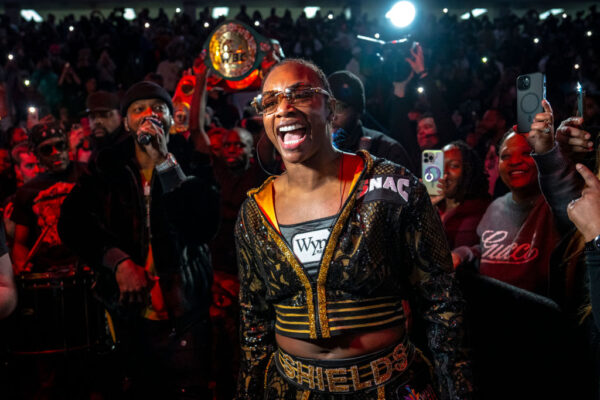
The bout on Feb. 22 capped the 11-fight card at Little Caesars Arena, where most of the matchups featured women. The venue was packed. Detroit Mayor Mary Sheffield and Lt. Gov. Garlin Gilchrist sat ringside as Shields entered in money green and gold trunks with blue hair, a tribute to her hometown of Flint and a reminder of the city’s water crisis. It turned out to be a lopsided match with Shields besting Crews-Dezurn. The scorecards were 100-90, 100-90, and 100-90.
Shields carries, according to Celebrity Net Worth, an estimated net worth of $1 million — a figure that underscores both her dominance and the economic reality of women’s boxing.
While that number is relatively low, according to data from BolaVIP, the 30-year-old has earned a cumulative $15 million over her career, including both her traditional boxing and MMA fights.
She has held multiple world championships across five weight classes and remains undefeated in 17 professional fights over nine years. Before turning pro, she became the first American woman to win Olympic gold in boxing, capturing middleweight titles at the 2012 and 2016 Summer Games.
Her recent contracts suggest her earning curve is finally catching up. The inflection point came with a landmark $8 million agreement with Salita Promotions and Wynn Records, according to Detroit News.
The deal guarantees at least four bouts and reportedly included a $3 million signing bonus. Shields said she tested the market before signing, receiving offers in the $1 million to $2 million guaranteed range. The larger upfront commitment proved decisive.
Structurally, the contract does more than raise her purse. It provides flexibility to speak with outside promoters about crossover opportunities — a notable concession in a sport where exclusive promotional ties often limit optionality.
The Crews-Dezurn bout, the first fight under the new framework, generated the kind of engagement promoters crave.
Beyond boxing, Shields competes in the Professional Fighters League as a mixed martial artist, diversifying both revenue streams and audience reach. The cross-sport visibility enhances sponsorship potential and strengthens her negotiating position in future boxing talks.
Her business circle has tightened as well.
Rapper Papoose, an executive at Wynn Records and her partner, is actively involved in her promotional ecosystem. In 2025, the prizefighter described his experience navigating major deals as a strategic advantage.
“It’s almost like he’s a cheat code,” she said, noting his guidance in high-stakes decision-making.
Shields has indicated she hopes to fight at least two more times in 2026. Each bout represents another data point — ticket sales, streaming metrics, sponsorship performance — that feeds into her next negotiation.