

In Alabama’s Black Belt, 87-year-old farmer Elister Charleston and his family are proving that land ownership, food sovereignty, and faith remain powerful tools in preserving Black wealth and legacy.
Still Farming
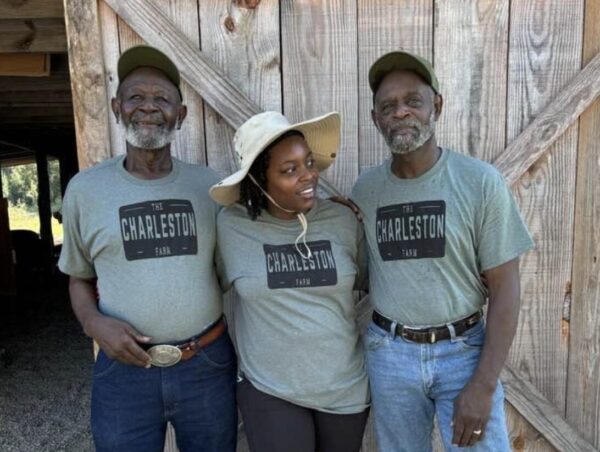
For more than four generations, the Charleston family has cultivated the same soil in Gallion, Alabama, transforming 24.5 acres into far more than a working farm –The Charleston Farm– at a time when Black-owned farmland has nearly disappeared across the United States.
“It’s in my bloodstream,” Charleston said of farming to Capital B News. “I loved how the dirt smelled when you break it up. Fresh, full of life, full of inspiration.”
That love of farming was passed down from his father, Edmond Charleston, who worked as a sharecropper during the Jim Crow era but never received the financial rewards of his labor.
“My daddy made plenty of cotton, corn, peanuts, sweet potatoes, okra and watermelon,” Charleston recalled. “But he never made any money.”
Charleston purchased his first parcel of farmland in 1982 after years of saving. Today, the family owns and operates 24.5 acres that produce collard greens, tomatoes, sweet potatoes, squash, watermelon, peppers, onions, beans, and dozens of other crops.
Generational sovereignty for Black farmers centers on reclaiming land, rebuilding ancestral agricultural knowledge, and establishing economic independence. The movement comes after an estimated 87% decline in Black farmland ownership over the past century, from nearly one million Black farmers cultivating roughly 16 million acres in 1920 to fewer than 46,000 Black farmers today, according to the NAACP.
According to the U.S. Department of Agriculture, Black farmers now account for only about 1.3 percent to 1.4 percent of all U.S. agricultural producers and control less than 0.35 percent of the nation’s farmland. Researchers estimate systemic discrimination, predatory lending, heirs’ property disputes, racial violence and unequal access to federal farm programs have contributed to the loss of more than $326 billion in generational Black wealth.
Although approximately 43,000 farmers recently received payments through the USDA’s $2.2 billion Discrimination Financial Assistance Program (DFAP), advocates say structural barriers remain. Earlier this year, the U.S. Department of Agriculture canceled the nearly $300 million Increasing Land, Capital and Market Access Program, an initiative created to help underserved farmers purchase land, secure financing and keep farms within families.
For the Charlestons, however, they aim on surviving by diversifying.
Elister’s son, Edmond Charleston, and granddaughter, Dr. Janie Charleston, have expanded the farm into a center for education, nutrition, and community health.
Janie, one of the few Black registered dietitians practicing in Alabama’s Black Belt, operates Bite and Bloom Collective from the family farm, where patients receive nutrition counseling alongside fresh produce harvested just steps away from her office, according to Capital B News.
Rather than simply discussing healthy eating, Janie often walks patients into the fields to pick vegetables prescribed as part of their treatment plans.
“If they can just eat one vegetable that we grow a week, it would make me happy,” she said.
The farm also hosts nutrition classes, educational tours, children’s story times beneath a centuries-old oak tree and community wellness events designed to reconnect families with fresh food and farming traditions.
Edmond continues many of the agricultural practices his father taught him, including planting according to the moon’s phases, watching seasonal winds and carefully timing crops around rainfall patterns passed down through generations.
“The farmer plays the part of life,” he said to Capital B News. “He’s your nourishment. He is your history. He is your strength. He is your way out of no way.”