

For generations, the Kennedy name has occupied a rare space in American culture — somewhere between political dynasty, old-money aristocracy, and Hollywood mythology. Long before hashtags and celebrity branding, there was Camelot: the carefully polished image of youth, wealth, elegance, and power surrounding President John F. Kennedy and first lady Jacqueline Kennedy.
A Piece of Camelot
More than 60 years after JFK’s assassination, that mystique still carries enormous financial value, proven once again by the sale of the couple’s former Georgetown mansion.
The Washington, D.C., home once owned by John and Jackie Kennedy has officially sold for $6.125 million after first hitting the market for $7.5 million last fall. According to Elle Décor, while the final price weighed in more than 18 percent below the original ask, the property remains one of the most historically significant residential sales tied to an American political family in recent memory.
Located in Georgetown, the stately Federal-style townhouse — known as the Marbury House — dates back to 1811. The home was originally tied to William Marbury, the figure behind the landmark Supreme Court case Marbury v. Madison, which established judicial review. Its cultural cachet exploded decades later when a young senator from Massachusetts and his glamorous wife transformed it into the nerve center of a future presidency.
John and Jackie Kennedy purchased the residence in 1957 for $82,000, when JFK was still a junior senator. Jackie reportedly invested another $18,000 redesigning the interiors with antiques and European-inspired décor that would later become synonymous with the Camelot aesthetic.
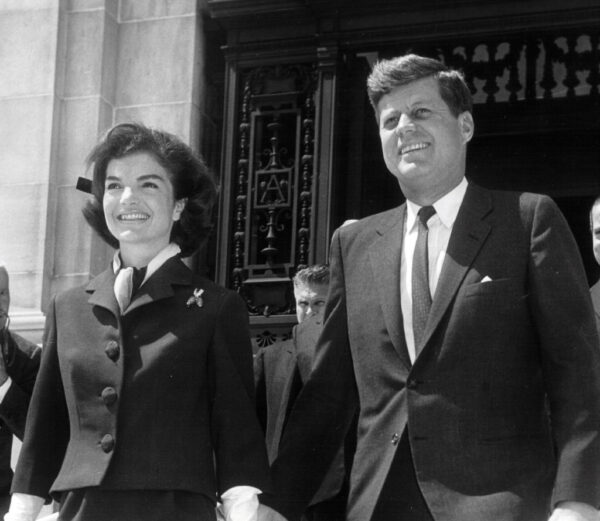
The 5,200-square-foot townhouse became far more than a family home. Caroline Kennedy and John F. Kennedy Jr. were both born during the family’s time there, and it evolved into an informal political war room during JFK’s 1960 presidential campaign. Perhaps the home’s most famous moment came on inauguration day in 1961, when John and Jackie were photographed leaving en route to the White House — an image that helped cement the beginning of Camelot.
But while Camelot projected extraordinary wealth and glamour, the actual finances of John and Robert Kennedy were more complicated than many Americans realized.
Much of the family fortune existed within sophisticated trust structures created by patriarch Joseph P. Kennedy Sr. Rather than directly owning massive liquid fortunes, the Kennedy children benefited from annual trust distributions designed to preserve wealth across generations.
At the time of his assassination in 1963, JFK’s personal estate was valued at approximately $1.9 million — roughly $19 to $20 million in today’s dollars. His will left Jackie a direct bequest of just $25,000 outright, with the remainder divided into trusts benefiting her and their two children. Robert F. Kennedy’s financial picture was similarly modest; estate filings following his 1968 assassination reportedly revealed debts and costs that dramatically reduced the net value of his estate.
The true financial engine behind Camelot was Joseph Kennedy Sr.’s long-term investment architecture.
Beginning in the 1920s, the patriarch established a network of generation-skipping trusts specifically designed to preserve wealth while encouraging public service. During their lifetimes, both JFK and RFK reportedly received annual trust distributions of approximately $500,000 — worth millions when adjusted for today’s purchasing power.
That structure allowed the Kennedy fortune to survive the assassinations that defined the end of Camelot. One major turning point came in 1998 when the family sold the Merchandise Mart in Chicago — once one of the largest commercial buildings in the world — to Vornado Realty Trust for $625 million, marking the end of the Kennedys’ era as major commercial property operators, according to Social Life Magazine.
Even Jackie Kennedy Onassis’ estate reflected the tension between prestige and liquidity. After her death in 1994, her heirs faced a federal estate tax bill reportedly exceeding $30 million. To cover it, Caroline and John Jr. authorized the now-famous Sotheby’s auction of Jackie O.’s personal belongings, which generated more than $34 million, the Washington Post reported in 1996.
Today, the broader Kennedy fortune is estimated between $1.2 billion and $1.8 billion, spread across multiple family branches and managed through structures tied to Joseph P. Kennedy Enterprises.
