

Sophie Cunningham knows that numbers matter in professional basketball. But when someone tried comparing her performance to one of the NBA’s highest-paid superstars, the Indiana Fever guard had another set of figures worth discussing.
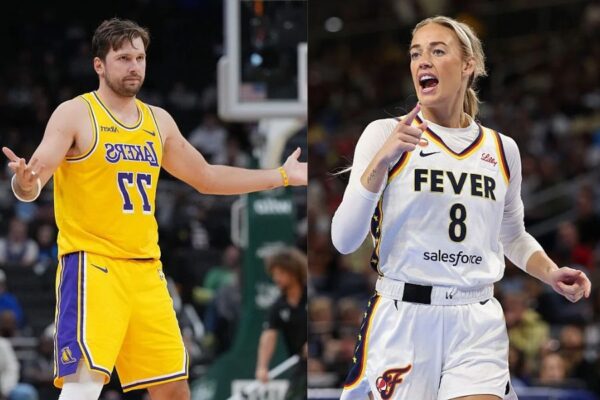
Comparing Apples to Oranges
The outspoken WNBA veteran wasn’t interested in letting the conversation revolve around statistics alone. After all, there is more than one way to measure what professional athletes bring to the court.
During a Nov. 12 episode of the “No Hesitation” podcast, NBA trainer Drew Hanlen compared Cunningham’s shooting numbers to those of Los Angeles Lakers superstar Luka Dončić.
Hanlen noted that Dončić had attempted 221 field goals in just nine games. Cunningham had attempted 226 during her entire 43-game WNBA season. He also pointed out that Dončić had already attempted 102 free throws, compared to Cunningham’s 74.
Cunningham quickly reminded him that their bank accounts were playing in different leagues.
“You’re missing a big one. He also makes $50 million a year. I make $700,000 on my WNBA check,” Cunningham responded.
She suggested another NBA player as a more reasonable comparison.
“You should compare me more to Quentin Grimes. You know, we average around, you know, eight to 10 points,” she said. “My 3-point shooting is actually better than the both of them. And so if we’re going to compare, let’s compare.”
The financial difference is staggering.
According to Her Hoop Stats, Cunningham signed a one-year, $665,000 contract with Indiana in April 2026. That represented a significant increase from the approximately $100,000 she earned in 2025.
Dončić, meanwhile, signed a three-year, $165 million contract extension with the Lakers in August 2025. His salary for the 2026-27 season is approximately $49.5 million.
That means Dončić earns roughly 74 times Cunningham’s annual WNBA salary. The comparison excludes endorsement income and other business opportunities.
Even Grimes, whom Cunningham suggested as a more suitable statistical comparison, reportedly earns $13.9 million annually. That is nearly 21 times Cunningham’s salary.
The numbers reflect a much larger financial divide between the NBA and WNBA. They also come during a historic period of salary growth for women’s basketball.
Las Vegas Aces superstar A’ja Wilson secured a three-year supermax extension reportedly worth $5 million in April.
Indiana Fever standout Aliyah Boston signed an even larger four-year agreement worth approximately $6.3 million. The contract established a new benchmark for total guaranteed value in the women’s league.
Those agreements followed the WNBA’s new collective bargaining agreement, which dramatically increased player compensation. The league’s salary cap rose to $7 million per team for 2026.
For Cunningham, the financial progress is personal.
During an appearance on comedian Theo Von’s podcast, she recalled taking home approximately $28,000 after taxes during her rookie season in 2019.
“I need to get a job,” she remembered thinking.
The Phoenix Mercury selected Cunningham in the second round of the 2019 WNBA draft. Her early earnings were a far cry from the salary she commands today.
However, player salaries represent only one piece of the financial picture.
WNBA star Angel Reese has transformed her basketball fame into a growing business portfolio. Her partnerships include Reebok, Victoria’s Secret, McDonald’s and Cash App.
Cunningham has also capitalized on her popularity. Her endorsements, media appearances and personal brand have created opportunities beyond her playing contract.
Still, the gap between the leagues remains enormous. The NBA generates substantially more revenue through broadcasting, sponsorships and other commercial agreements. Those differences help explain its much larger player contracts.
Cunningham wasn’t dismissing Dončić’s talent, either.
“He’s killing it. Like, he has been so much fun to watch,” she said.
Her response was delivered with humor, but the financial figures spoke for themselves. Even as WNBA salaries reach new heights, the distance between the men’s and women’s leagues remains measured in millions.